Key takeaways
- The concept of AI assistants is to reduce user workload.
- Platypus OS connects to 1500 applications for seamless integration.
- AI can help automate tasks across various business functions.
- Building a personal assistant with AI is more cost-effective for businesses.
- Iterating on product ideas is crucial for finding market fit.
- Testing different software tools is essential for making informed decisions.
- AI's future will likely involve less reliance on traditional front-end interfaces.
- Listening to customer feedback is vital for product improvement.
- Networking can significantly impact business growth and opportunities.
- Being open to change is necessary for entrepreneurs.
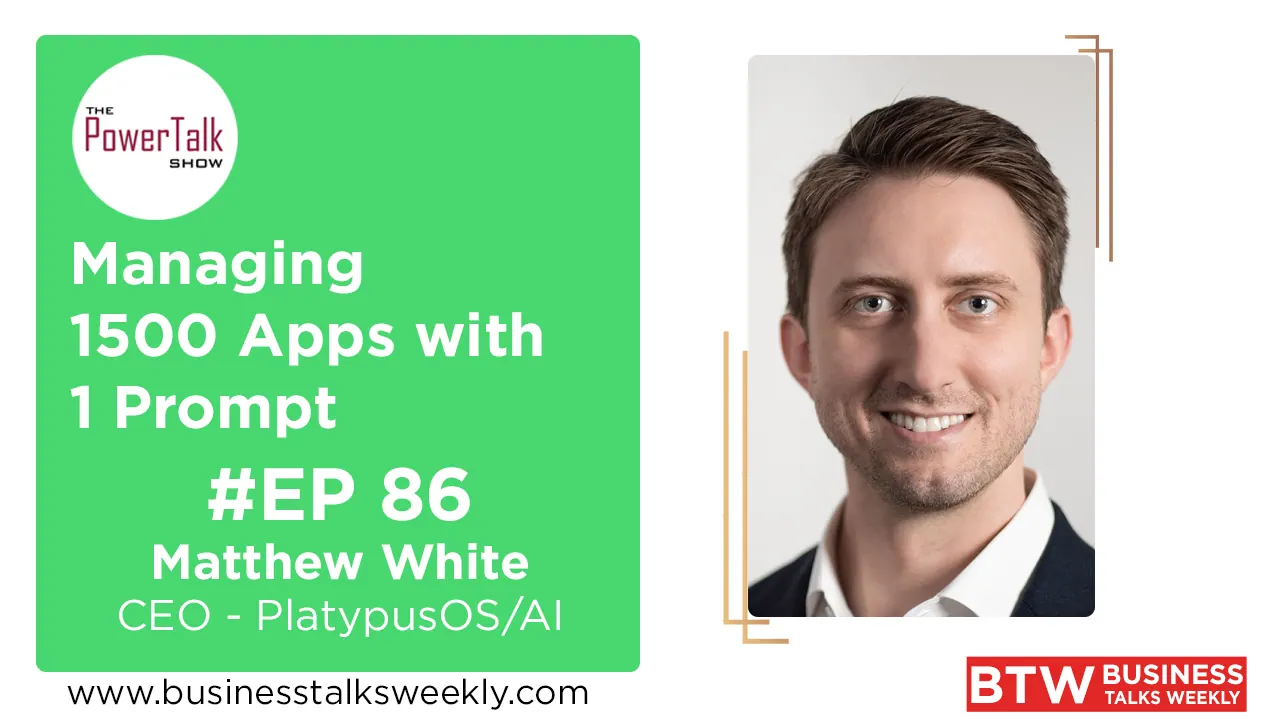
In this episode, we spoke with Matthew White, a seasoned entrepreneur and the CEO of PlatypusOS/AI. Matthew’s current venture aims to build an AI assistant—similar to the concept of Jarvis—that fundamentally changes how people interact with the internet and manage their business operations.
Matthew’s journey started with Qebot, a SaaS marketplace designed to simplify software access for business owners. With the explosion of AI, he realized the potential to go a step further: eliminate the need for users to sit at their computer and type all day.
The AI Assistant Revolution: API-Driven Automation
The concept behind PlatypusOS/AI is to create an actual personal assistant that works on the user’s behalf. This assistant connects to a vast ecosystem of over 1,500 different applications—from HR and marketing tools to CRMs and ERPs—and manages them via AI prompt.
For small and medium-sized business owners, this means:
“Instead of sitting at your computer at the end of the day and saying, okay, I need to move this specific user from prospecting into contracting in my CRM and then send them an invoice… you can now do that via AI prompt.”
The Key Differentiator: API vs. Front-End
Matthew explained that while competitors like OpenAI and Perplexity offer great personal assistants for front-end tasks (like booking flights or editing an email), PlatypusOS focuses heavily on the business side using API-driven connections.
This is the critical difference: in their system, you don’t need to have a browser window or tab open for the application you’re working with. You can simply prompt, “I want my CRM to do this, this, and this,” and the AI executes the command across the API. This enables true multi-application workflows where the AI can seamlessly operate across six different tools at once—an efficiency similar to what a product like Zapier offers, but driven by natural language AI.
The Future is Agent AI: Goodbye, Websites?
Matthew envisions a future where the need for traditional software interfaces and websites is greatly diminished. He sees the future of software as a whole becoming much more AI prompt-based.
“I think that the idea of websites is going to change dramatically… I think the future that I see is much more us [like] the show Star Trek: The Next Generation where they’re like, ‘Computer, do this for me. Computer, do that for me.’”
This future is about freeing people from mundane, clerical work so they can focus on higher-value activities. The shift will transform websites, even for services like a plumber, into highly functional chat-based interactions where the AI handles scheduling, cost structure, and support queries instantly.
He also sees AI democratizing development: AI agents can now help non-coders build their own applications and complex, no-code workflows simply through natural language prompts.
The Hard Lessons of Entrepreneurship
With 15 years of company building under his belt, Matthew offered two crucial pieces of advice for fellow founders:
- Listen to Your First Customers (Even When It Hurts): Matthew emphasized the importance of iterating rapidly based on user feedback. In the early days of Qebot, his team transitioned their product three or four times to find the right product-market fit.”You gotta suck it up and say, hey, okay, this is real feedback from real users… Let me go back to the drawing board and see what we can do. So don’t be afraid to iterate on what you’ve built.”
- Move Faster: If he could go back and advise his younger self, he would say: move faster. If you have a gut feeling about a product direction or the people you’re working with, make a decisive change quickly. Building a company requires the ability to take emotion out of key decisions and operate with speed and agility.
The Perspective-Changing Advice: Build Your Network
The single piece of advice that changed Matthew’s perspective both professionally and personally was the adage: “Your network is your net worth.”
He initially focused only on product development, but quickly learned that your network is critical for everything from fundraising to getting your first customers. He encourages entrepreneurs to dedicate time to building relationships, going to networking events (even when tired!), and offering genuine help. That assistance will eventually be remembered and reciprocated.
In Matthew’s words
“AI can help you code.”
“You need to be open to change.”
“Listen to your customers.”
Frequently asked questions
What is PlatypusOS/AI?
PlatypusOS/AI, led by CEO Matthew White, is an API-driven AI assistant that connects to over 1,500 business applications — including CRMs, ERPs, HR and marketing tools — letting users manage them through natural language prompts instead of manually navigating each app.
How is PlatypusOS different from assistants like OpenAI or Perplexity?
Matthew White explains that while those tools excel at front-end personal tasks like booking flights, PlatypusOS focuses on API-driven business workflows — executing commands across multiple connected applications at once without needing a browser tab open for each one.
What does Matthew White see as the future of websites and software?
He predicts software interfaces will shift heavily toward AI prompt-based interaction, comparing it to Star Trek’s "Computer, do this for me" model — with even service businesses moving toward chat-based interfaces that handle scheduling and support instantly.
What is Matthew White's biggest lesson from 15 years of building companies?
Two things: listen to your first customers and iterate quickly even when feedback is hard to hear (his team pivoted Qebot three or four times to find product-market fit), and build your network early since it becomes critical for fundraising and finding customers.