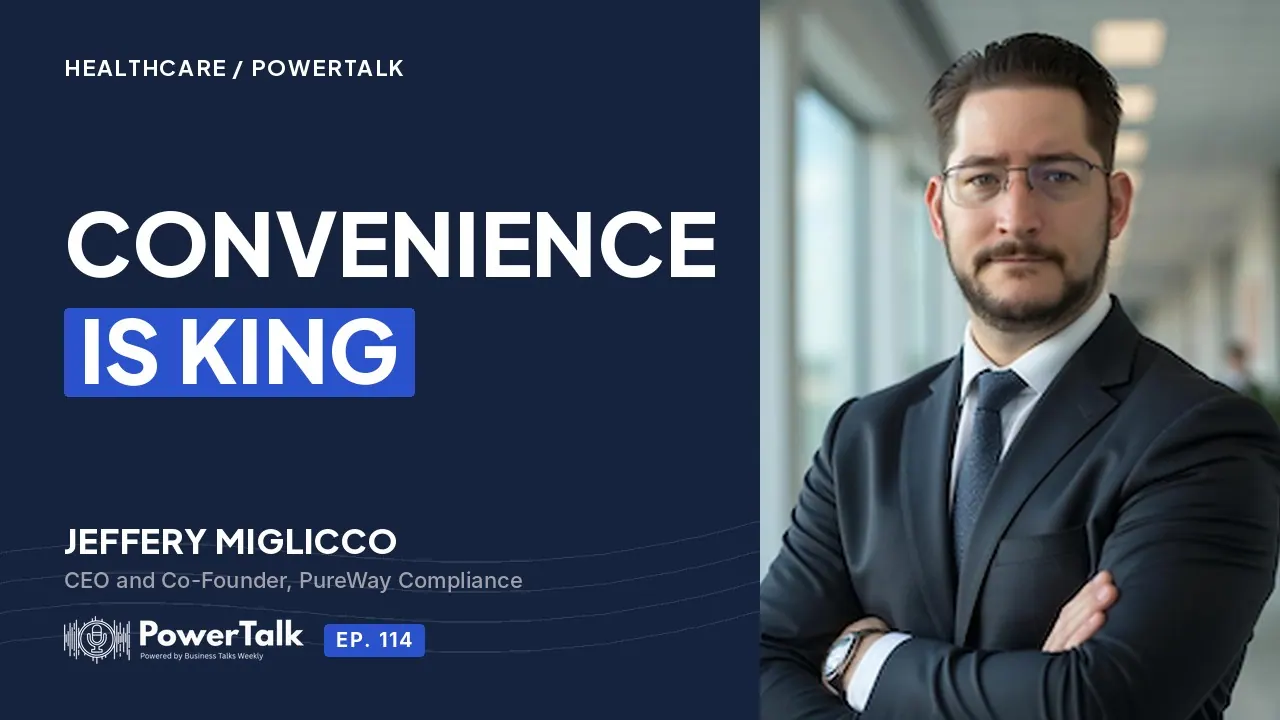
Jeffery Miglicco is the CEO and co-founder of PureWay Compliance, a Houston-based company he started in 2013 to solve a problem most people never think about: what happens to needles and medical waste once healthcare leaves the hospital. On Episode 114 of The PowerTalk Show, he tells host Navin Shetty how a mail-back kit became the answer, why he expects home injections to be regulated across more US states, and how his team uses AI without handing over its thinking.
Key takeaways
- Jeffery Miglicco started PureWay Compliance in 2013 and invented a mail-back kit for needles and medical waste from clinics, pharmacies and homes.
- He estimates more than 100 million people inject at home in the US, and puts the home waste market alone at more than $5 to 10 billion.
- California’s SB 212 makes drug manufacturers responsible for disposal options for home sharps; New York and Oregon are looking at similar rules.
- At PureWay the team does the thinking, scoping and checking, while AI does "the rowing in the middle": three jobs in eight hours became 12.
- By Jeffery’s figure, PureWay is up 48% this year and plans to double in size every two and a half to three years.
Convenience care moved healthcare waste out of the hospital
Jeffery’s starting point is a change in how people get care. A visit to a doctor’s office used to be the default. Now people walk into a pharmacy for a flu jab, use a walk-in clinic, or speak to a doctor on their phone within minutes. That convenience gave patients more control, and it also scattered waste that used to be collected in one place.
He noticed the shift early and invented a mail-in kit: containers plus a mail-back compliance process. Dental offices, pharmacies running vaccination programmes, weight loss clinics and people injecting at home fill the box and drop it in a regular mailbox or at a shipping counter. “Convenience is king here,” he says, and the same logic runs through everything PureWay builds.
COVID sped it up. Remote work widened the hiring pool, more people stayed at home, and more healthcare followed them. Jeffery points to hospital-at-home programmes, where a stable patient is sent home with a bed, monitors and a daily physician check-in instead of taking up a hospital bed. Every one of those homes now produces medical waste.
The home injection market is bigger than the clinic market
Jeffery’s own estimates, which he says are based on older data, put the number of US healthcare facilities that generate regulated medical waste at around 1.5 million, in a market worth 15 to 20 billion dollars. The home side is larger. He counts more than 100 million people injecting at home in the US, from insulin users to owners of diabetic pets, and puts the home market alone at more than five to ten billion dollars.
GLP-1 weight loss drugs are adding to it. People share their journeys openly, which has moved injections out of healthcare and into wellness. PureWay works with what Jeffery calls a safe number of half a million patients, still a small share of the people who need a disposal option. As with Anthony Mongiello’s approach to building a niche with original products, the opportunity sits where the established players are not looking.
Why SB 212 and needle sticks will spread regulation
California’s SB 212 changed the economics of home sharps. It identifies the waste people produce at home and puts the responsibility on pharmaceutical manufacturers to offer a disposal option for anyone who injects at home. Programmes funded by CalRecycle or by the manufacturers now provide free kiosks and mail-back kits, and people can face penalties for putting syringes in household rubbish.
New York and Oregon are looking at similar bills, and Jeffery expects the strongest push to come from workers rather than patients. Refuse collectors are seeing more needle-stick injuries. Plumbers open a blocked pipe and find five or six syringes that someone flushed. Add a public that no longer feels comfortable throwing a needle in the bin, and he sees a market that is largely unregulated today but will not stay that way.
Using AI to accelerate the team, not replace it
PureWay let its team go wild with AI at the start of the year. About 90 days later, Jeffery says he could no longer tell which work came from his people and which came from the tools, so he called a pause. The rule they settled on: the team does the critical thinking, draws the roadmap, scopes the work and checks it at the end. AI handles “the rowing in the middle”.
By his account, someone who did three jobs in eight hours can now do 12 in the same time. That creates a new management problem: people feel more tired because more gets done, and they expect to earn more for it. His advice is to aim for a team that is twice as productive at the same accuracy, not a hundred times, and to take the wins one step at a time. Brendan Gow made a related case for why AI can’t replace the client relationship on Episode 111.
Faith, focus and slowing down to speed up
Jeffery describes his faith as his compass. It sets how he treats people and how the business is run, and it makes him “proud of the process, not just the profits”. He wants to look back in ten years and see that PureWay built leaders as well as a company, and that nobody felt like a number on a spreadsheet.
Focus is the other discipline. Forza Ventures, his earlier vehicle for real estate and AI projects, is on the back burner. All effort goes into PureWay, which he says is up 48% this year and plans to double in size every two and a half to three years.
His two lessons for founders come from failing early in his career. First, slow down to speed up: when hyper-growth leads to mistakes in the basics, stop, re-sharpen and go again. Nikki Stone’s episode on why success creates chaos covers the same trap. Second, if you want to go fast, go alone; if you want to go big, build a team. Jeffery says he is “less and less relevant every day”, and he means it as praise for the people around him.
More founder conversations on growth, teams and leadership are in the Leadership and scaling archive.
In Jeffery’s words
“If you want to go fast, you go alone. If you want to go big, if you want to have a really big impact, you need to build a team.”
“You have to slow down to speed up. You cannot operate so quickly that you stop doing the basics very well.”
“Convenience is king here. If we can receive high levels of health care at home, and there’s trust with that, that is gonna continue to grow.”
“The way that we found to use AI is not to replace the critical thinking and not to replace the subject matter experts that really drive our business.”
Frequently asked questions
What does PureWay Compliance do?
PureWay Compliance, founded by Jeffery Miglicco in 2013 and based in Houston, provides mail-back kits and compliance programmes for sharps and medical waste. Clinics, pharmacies, dental offices and people who inject at home fill a container and send it back by regular mail for safe disposal.
What is California SB 212?
SB 212 is the California law that covers home-generated sharps and pharmaceutical waste. As Jeffery explains, it places responsibility on pharmaceutical manufacturers to offer disposal options, such as kiosks and mail-back kits, for people who inject at home. This is general information, not legal advice.
How big is the market for at-home injection waste?
Jeffery estimates that more than 100 million people inject at home in the US and puts the home waste market at more than $5 to 10 billion, with the regulated facility market at $15 to 20 billion. These are his own estimates, based on what he called older data.
How does PureWay use AI?
The team does the critical thinking, sets the roadmap, scopes the work and checks the result, while AI speeds up the steps in between. Jeffery says this lets one person do 12 jobs in the time three used to take, and advises aiming for steady gains rather than replacing people.
What is Jeffery Miglicco’s advice for founders?
Slow down to speed up: when fast growth causes mistakes in the basics, stop and re-sharpen. And if you want to go fast, go alone, but if you want to go big, build a team of people who are better than you at their part of the business.