Key takeaways
- Chris Miles is known as the anti-financial advisor for his unconventional approach.
- He emphasizes the importance of cash flow over traditional saving methods.
- The FIRE movement may not be the best path to financial independence.
- Diversification in investments is crucial to mitigate risks.
- Investing in passive income opportunities can yield better returns than the stock market.
- Young professionals should focus on increasing their value and income first.
- Education and training are vital for career growth and financial success.
- Creating value for others leads to financial rewards.
- Avoid putting too much money with a single investment operator.
- The stock market may not be the safest place for investments right now.
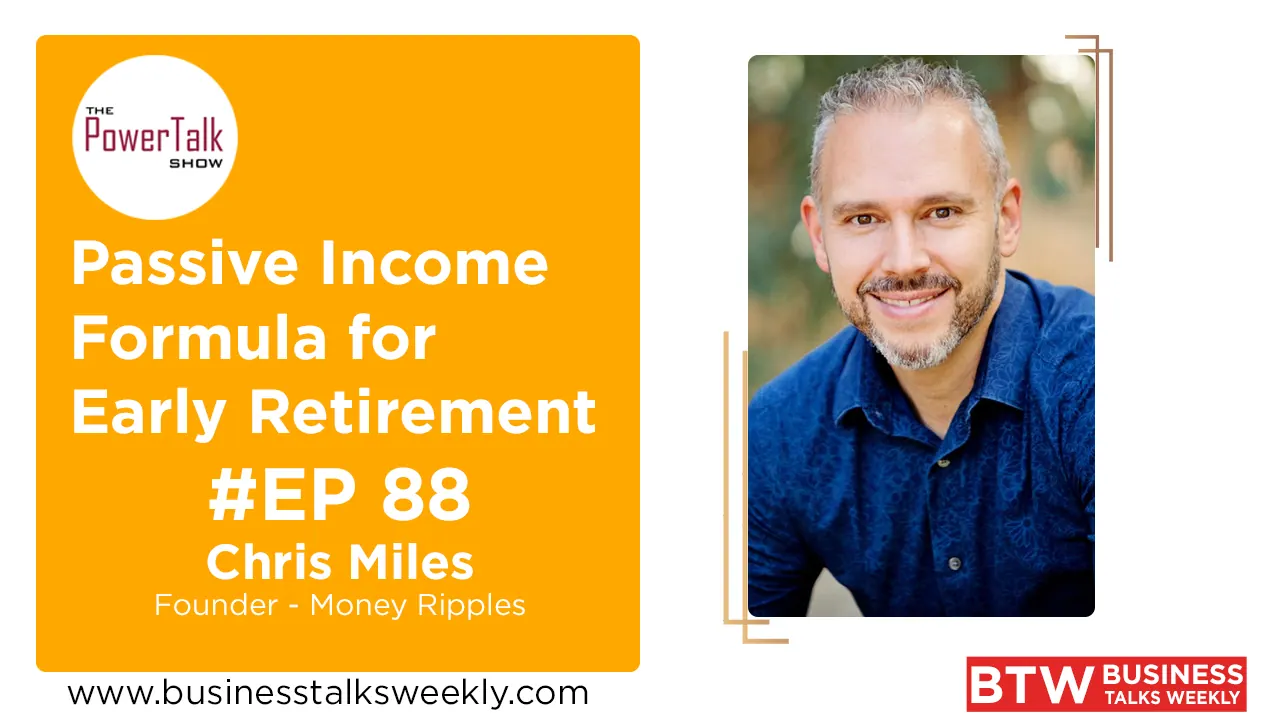
Welcome back to The PowerTalk Show, powered by BusinessTalksWeekly.com! We were joined by Chris Miles, known as the Cash Flow Expert and Anti-Financial Advisor. After a startling realization that his own penny-pinching father—a model saver—would run out of money just five to six years into retirement using traditional methods, Chris did the unthinkable: he left the financial advisory industry.
Chris then shifted his focus entirely to passive income and investing in real assets. The result? He achieved financial retirement not once, but twice—first at age 28, and again at 39 after going broke in the 2008 recession.
Why Chris is the “Anti-Financial Advisor”
The core of Chris’s philosophy lies in rejecting the “accumulation theory” taught by Wall Street: saving endlessly in volatile markets like the stock market (401(k)s, mutual funds) with the hope that compounding will eventually lead to wealth.
“Don’t listen to what those guys teach about gambling in the stock market where you’re going to make low, know, mediocre returns with high risk. Don’t do that. Do this instead. You’ll save decades of pain and worry.”
The Anti-FIRE Movement: Rethinking Retirement
Chris is even an “anti-FIRE” advocate. He argues that the popular Financial Independence, Retire Early (FIRE) movement, which often relies on saving heavily into the S&P 500 and strictly following the 4% Rule, is fundamentally flawed and too slow.
The Math of Passive Income vs. Stock Market:
- Traditional Method (Stock Market/4% Rule): To generate $5,000 per month ($60,000 per year), you would need to save up close to $2 million.
- Passive Income Method (Real Assets/Lending): If you invest in real estate lending that pays 12% annual interest, you only need approximately $500,000 to generate the same $5,000 per month.
Chris emphasizes that the key to retiring decades earlier is moving away from the stock market and focusing on real assets that create immediate income.
Strategies for Passive Income Generation
Chris recommends focusing on passive investments where your money works for you with minimal hands-on effort. These strategies are often only utilized by the wealthy, but are accessible to the common man:
- Lending to Real Estate Investors: This was Chris’s first strategy. He found real estate operators willing to borrow money and pay guaranteed annual returns of 10% to 12% or more. This provides immediate, high-rate cash flow.
- Real Assets: Investing in non-Wall Street, tangible assets like:
- Oil and Gas ventures
- Car wash businesses (joint ownership)
- Self-storage units (especially during economic downturns)
- Apartment buildings (especially when the market is depressed)
- Life Insurance Policies (U.S. Tax-Free Savings): Chris holds a large chunk of his money in whole life insurance policies for their tax-free savings account (cash value) component. This money is earning 6% per year tax-free with no risk, which provides a stable, safe haven during market volatility.
Navigating Uncertainty and the Overvalued Market
Chris warns that the current economic environment, especially the U.S. stock market, is dangerously overvalued and being manipulated by algorithmic trading.
“I really believe that the worst place to have your money right now would be the stock market… The truth is what we’re finding out in the U.S. is that because they were lying about their numbers… we’ve been in a recession since about April of last year.”
He advises investors to look for assets that are currently out of favor—”look to see what nobody wants to put their money in,” because that is usually where the next opportunity lies.
Diversification Rule
While the specific percentage allocation (real estate vs. oil and gas) should align with a person’s financial goals (income now vs. long-term growth), Chris provides one crucial diversification rule:
- Do not put more than 25% of your money with one company or one operator. Over-relying on a single operator, even if they run multiple investments, creates massive concentration risk, as one client learned the hard way when oil prices dropped.
The Best Advice for Young Professionals
For young professionals just starting out, Chris says to ignore investing completely for the first few years.
His advice is singular: Focus on becoming valuable.
- Increase Value, Increase Income: Invest in your own education and training to become indispensable to your employer or customers. Chris’s success during his own financial crisis was due to focusing on solving problems (helping people find free up cashflow/save on taxes), which made him more valuable.
- The Formula: Dollars Follow Value: “Stop asking, ‘How do I make more money?’… The best thing to do is what can I do to create a win-win for people? How can I serve them? How can I solve problems for them… so that they want to exchange money?”
- Save, Then Invest: Save up your increasing income (even if it’s just in a high-yield bank account or a safe vehicle like the life insurance strategy) until you have a critical mass (e.g., $150,000 – $250,000). Then start investing in the passive income strategies that accelerate wealth.
For a very different take on where founders put their capital, Jen Millard explains why she calls water in a can an anti-AI investment.
In Chris’s words
“Don't listen to financial advisors!”
“I went broke and had to do it again.”
“Stop asking how to make more money.”
Frequently asked questions
Why does Chris Miles call himself the "anti-financial advisor"?
He rejects the traditional "accumulation theory" of saving heavily into volatile markets like 401(k)s and mutual funds, instead building wealth through passive income from real assets outside Wall Street.
How much do you need to retire on $5,000 a month, according to Chris Miles?
Using the traditional stock market 4% Rule, roughly $2 million. Using passive income strategies like real estate lending paying 10-12% annual interest, Chris says roughly $500,000 can generate the same monthly income.
What is Chris Miles' diversification rule?
Never put more than 25% of your money with a single company or operator, even if that operator runs multiple investments — concentration risk with one party can be just as dangerous as an undiversified asset class.
What does Chris Miles recommend for young professionals just starting out?
Focus first on becoming valuable — investing in your own education and skills to increase income — rather than investing right away. Once you've saved a critical mass, then move into passive income strategies.